


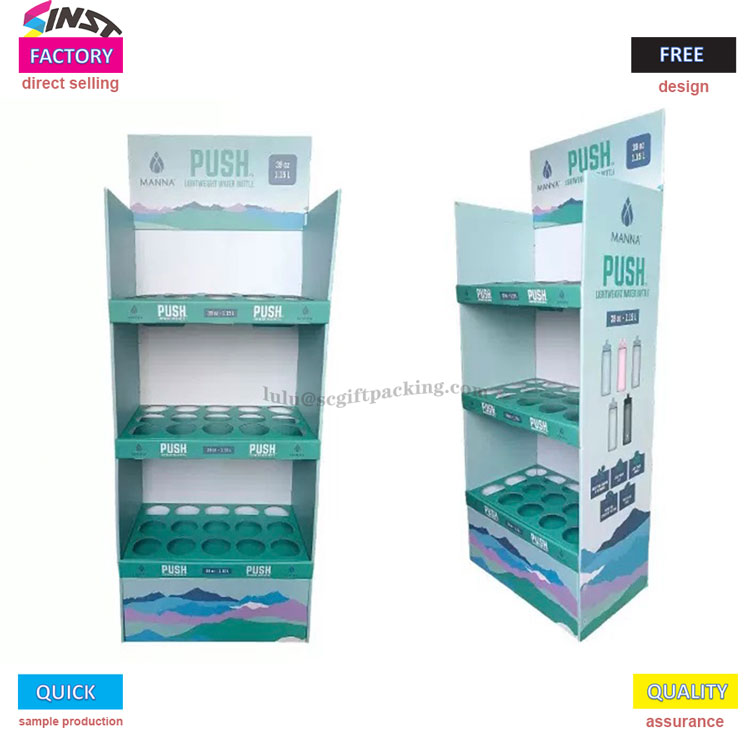
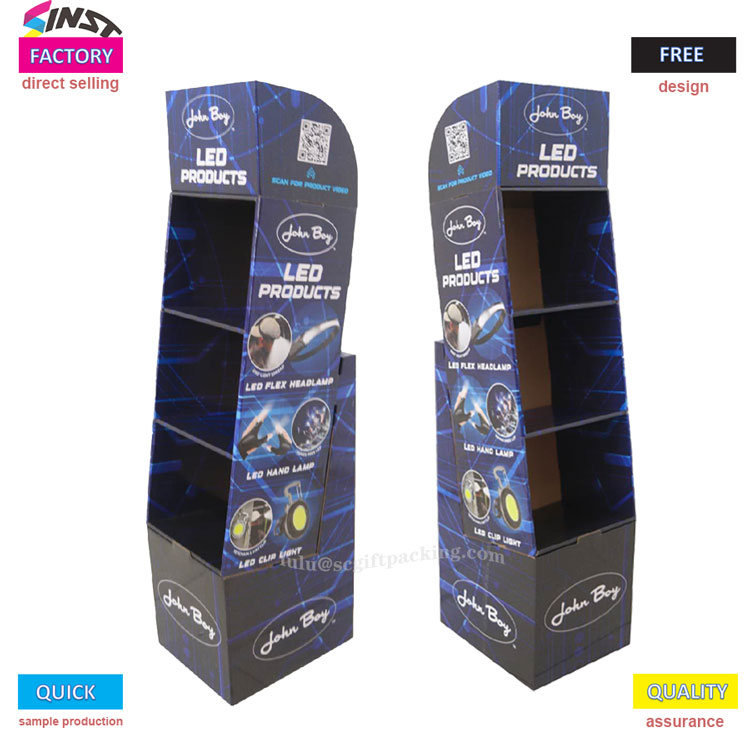
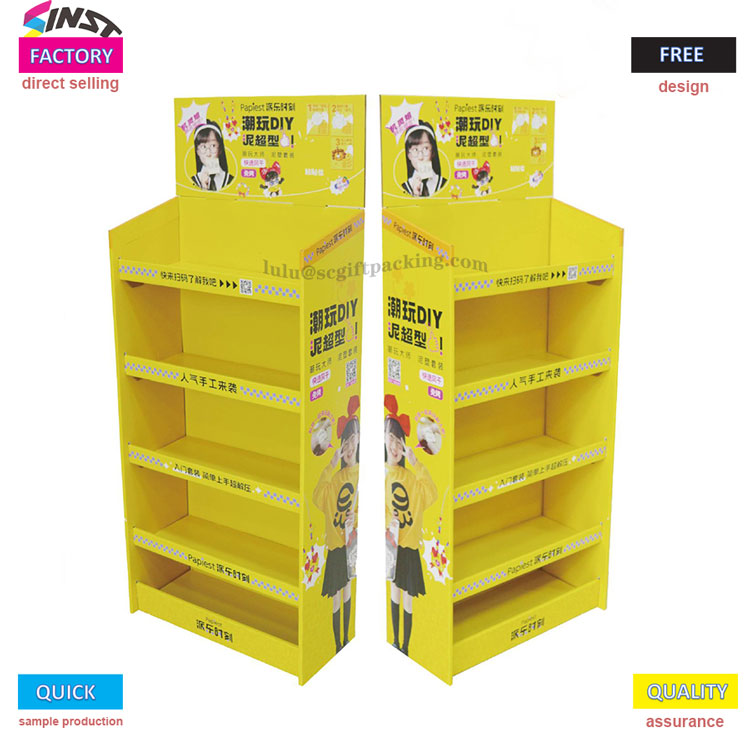

A Sturdy-Looking Display Can Still Fail Under Real Beverage Loads
A thick-looking beverage display isn’t necessarily a strong one. The usual mistake is approving an empty sample, then assuming it will behave the same way after three tiers are filled with water bottles. It won’t. Filled bottles create sustained downward loads, while shoppers pulling products from one side introduce twisting and uneven weight distribution.
Early warning signs include shelves dipping at the front, sidewalls bowing, crushed corners and a header that begins to lean. Moisture from floor cleaning, bottle condensation or a small leak can accelerate the damage. A cardboard carton floor display stand for supermarket water bottles must be evaluated as a loaded structure, not as printed packaging that happens to stand upright.
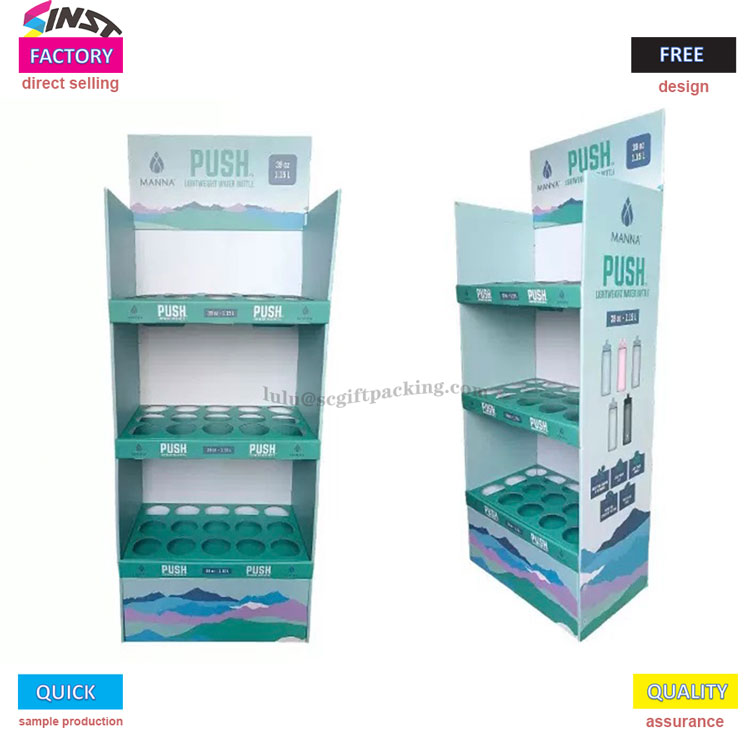
Bottle Fit and Load Paths Determine Whether Three Tiers Stay Level
In a three-layer grid structure, circular grooves keep bottles from rolling and help maintain an orderly presentation. They don’t carry the entire load. Weight still has to travel through each shelf, its supports, the side panels and the base without forcing the display out of square.
Set Circular-Groove Tolerances From Production Bottles, Not Nominal Diameters
Bottle drawings are useful, but physical production samples are better. Measure the widest relevant area and check molded ribs, tapered bodies, sleeves and cap geometry. A groove that’s too loose allows bottles to tilt or jump out during replenishment. One that’s too tight scuffs labels, slows removal and may tear at the die-cut edge.
Send the supplier several filled samples representing normal manufacturing variation. Test insertion and removal from every tier, including the rear positions. Thermos cups and milk tea cups deserve separate trials because their profiles and centers of gravity differ from standard bottled water.
Specify Filled Weight, Units per Tier, Board Grade, and Shelf Reinforcement Together
“Holds 12 bottles” is an incomplete specification. The RFQ should identify filled unit weight, bottle count on each tier, display duration and the expected replenishment pattern. Those details determine whether the grid, shelf edges or internal supports need reinforcement.
Uneven loading is especially revealing. Staff rarely replenish every position at once, and shoppers empty the most accessible row first. Ask for testing with full, partial and one-sided loads. If the structure leans under those conditions, changing the artwork or adding a heavier-looking outer sheet won’t correct the load path.
Treat 157 gsm Art Paper and 1500 gsm Cardboard as a Starting Construction, Then Validate Moisture, Edges, and Print Finish
Sinst lists 157 gsm art paper with 1500 gsm cardboard for its three-tier cardboard beverage display stand. That is a construction description, not a universal load rating. Board stiffness, grain direction, die-cut placement, adhesive coverage and shelf geometry all affect field performance.
Pay close attention to exposed edges. A crushed or poorly sealed edge can wick moisture and lose shape before the printed face shows obvious damage. Ask the prototype shop to inspect groove edges, base corners and shelf noses after loading and repeated bottle removal.
CMYK or Pantone printing can be paired with glossy or matte finishing. Gloss may suit bright beverage graphics and provide a more wipeable face, but reflections can interfere with some store lighting. Matte reduces glare yet may reveal rubbing differently. Print sample panels, then test scuffing at folded edges and contact points. Sinst describes the paper as 100% recyclable; confirm that any selected finish, adhesive or local disposal requirement fits your retailer’s recycling program.
Right-Size the Retail Footprint Without Shifting Cost Into Flat-Pack Labor or Outbound Shipping Volume
A larger base may improve stability, but it also consumes aisle space and increases the dimensions of the knocked-down pack. Shrinking the footprint can create a tall, narrow unit that tips or racks when shoppers remove bottles from one side.
Start with the retailer’s permitted footprint, shelf height restrictions and replenishment access. Then review the flat-pack drawing. Count separate parts, identify similar-looking panels and check whether locking tabs can be inserted without excessive force. Difficult assembly leads store teams to skip braces, reverse shelves or damage slots before the first bottle is loaded.
Packaging density creates another trade-off. More preassembly reduces store labor but can increase outbound shipping volume. More loose components may pack efficiently while raising assembly time and error risk. Approve the pack-out and instructions alongside the display—not after production tooling is set.
Approve Test Evidence, Not Board Labels or Supplier Claims, Before Production
Supplier credentials matter, but they don’t replace product validation. Sinst lists ISO9001, ISO14001, FSC, BSCI and SEDEX credentials across its product and company pages. Request current documents and applicable scope where your retail program requires them, particularly FSC chain-of-custody information. Then ask for test records tied to the approved display configuration.
Prototype Checks: Loading, Lean, Bottle Removal, Replenishment, and Repeated Assembly
Build the prototype using intended materials, print coverage and finishing—not an unprinted substitute with different behavior. Load all three tiers with actual filled products and leave the unit standing for the agreed retail period. Record shelf sag, leaning, crushed edges and groove damage.
Remove bottles from the front, back and one side. Replenish several times. Assemble and disassemble more than one sample so the evaluation catches ambiguous instructions, weak locking tabs and parts that only fit after being forced. A prototype that works only when assembled by its designer isn’t store-ready.
Transit Checks: Pack-Out, Edge Protection, Compression, Vibration, and Arrival Condition
Flat displays often fail before reaching the sales floor. Strapping can dent exposed edges, cartons can compress in stacked freight, and vibration can scuff printed panels or shake small components loose. Inspect the shipping carton, internal restraints and corner protection as a single pack-out system.
Run distribution testing suited to the actual shipping route and pallet pattern. Acceptance criteria should cover carton deformation, missing parts, print abrasion, warped panels and assembly after arrival. Photograph the unpacking sequence. Damage that appears “minor” in a warehouse can prevent tabs from aligning or leave a premium header visibly creased.
Turn Each Failure Symptom Into a Corrected Sinst RFQ Before the Listed 1,000-Piece Minimum Order
Sinst lists a 1,000-piece minimum order, samples and export shipping for this product category. Before approving that quantity, translate each observed problem into a measurable RFQ revision.
| Observed symptom | Likely issue | RFQ correction |
|---|---|---|
| Tiers lean or dip | Incomplete load specification or weak support path | State filled weights, tier quantities and uneven-load test conditions. |
| Bottles wobble or bind | Grooves based on nominal dimensions | Supply production bottles and approve die-cut fit samples. |
| Edges crush or soften | Poor edge protection, moisture exposure or transit compression | Define pack-out, handling conditions and arrival criteria. |
| Graphics arrive scuffed | Finish and carton restraint weren’t tested together | Approve printed transit samples with the selected matte or glossy finish. |
| Store assembly takes too long | Too many parts or unclear locking sequence | Set an assembly trial and require illustrated instructions. |
Mark those corrections directly on the drawing and prototype report for the custom printed water bottle floor display. Don’t accept “reinforced” or “improved” without identifying the changed material, part or test result. Reload the revised sample, repeat the failed condition and approve production only after the symptom disappears.