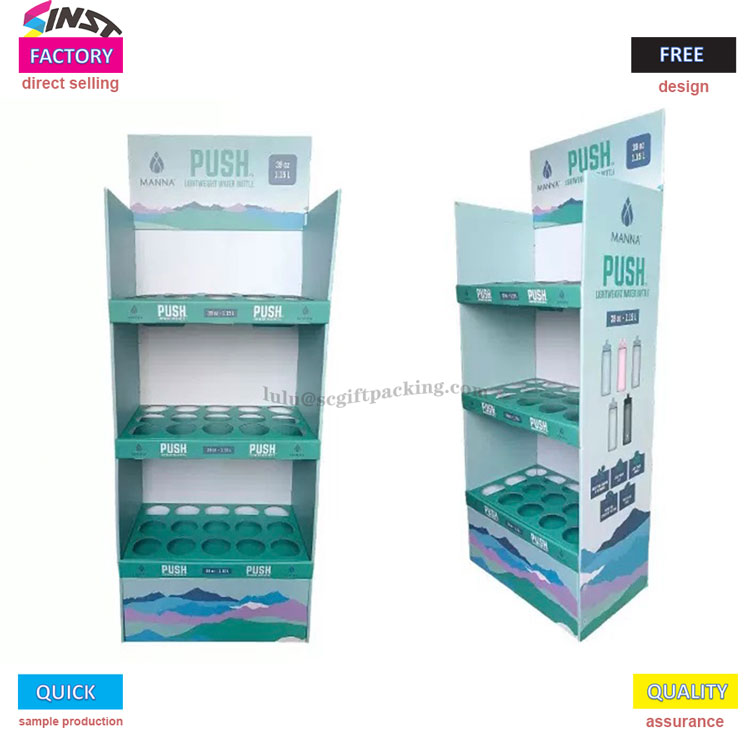
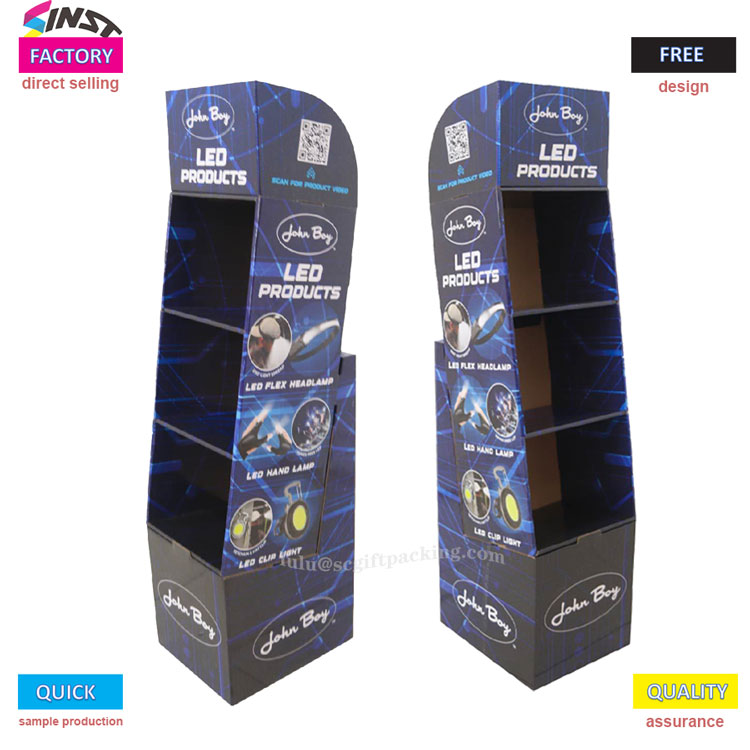
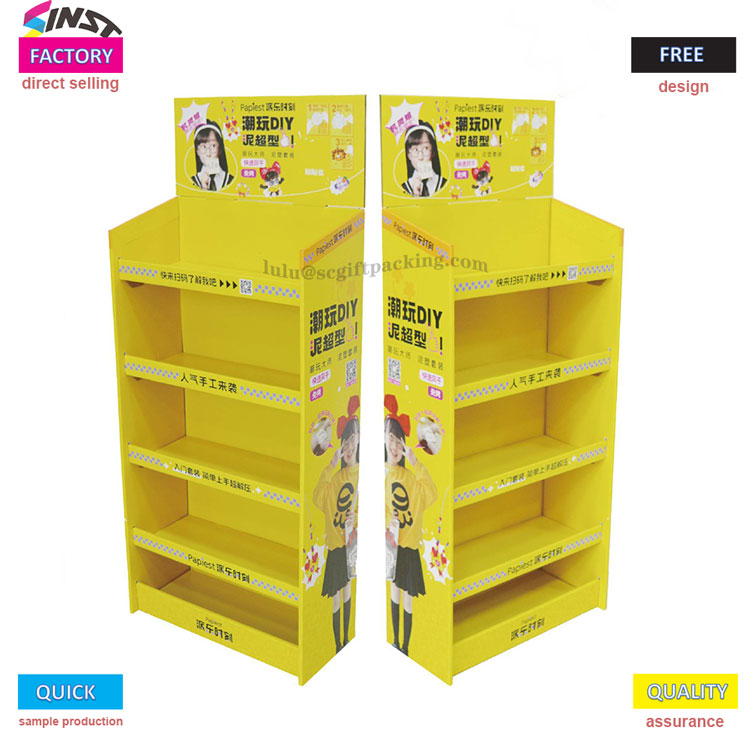
Walk through a supermarket on a Friday afternoon during a major holiday promotion, and you will likely see a cardboard display struggling to survive. Shelves bow under the weight of metal cookie tins. The bottom tier shows water damage from nightly floor scrubbing. Shoppers pull heavily from one side, leaving the entire structure leaning precariously into the aisle.
Merchandisers often treat temporary POP (Point of Purchase) fixtures like disposable paper products. That is a costly mistake. When a display fails, you lose more than the cost of the cardboard. You lose the prime retail real estate you negotiated, you risk damaging expensive inventory, and you create a tripping hazard.
Displaying dense, heavy merchandise like stacked gift boxes or two-pound cookie tins requires specific structural engineering. A standard shopping mall biscuit cardboard display rack must act as a load-bearing fixture, not just a billboard. Understanding how these racks hold weight, resist environmental stress, and maintain their shape is the only way to prevent mid-promotion collapses.
Diagnosing Display Failures in High-Traffic Supermarkets
Cardboard retail displays rarely fail immediately upon setup. They succumb to a process known as "creep"—the slow, continuous deformation of a material under a constant load. In a retail environment, three specific forces accelerate this failure.
The first is center-point loading. Standard corrugated displays rely entirely on their outer side walls to support the shelves. When merchandisers stack dense biscuit tins in the center of a wide shelf, gravity pulls the middle downward. This bowing pulls the side walls inward, destabilizing the entire rack.
The second failure mode is uneven stock depletion. Shoppers rarely take products evenly from across a shelf. They grab from the most accessible side. If a shelf holds 40 pounds of baked goods and 30 pounds are removed from the left side, the remaining weight creates lateral torque. Weak displays will twist, causing the shelf tabs to tear out of the back panel.
Moisture wicking is the third and most common killer of floor-standing racks. Commercial floor scrubbers leave behind residual water. If a cardboard base sits directly on the tile, capillary action draws that water upward into the fibers. The corrugated flutes soften and crush under the weight of the merchandise above them, causing the entire display to pitch forward.
How 1500gsm Cardboard and Grid Designs Distribute Weight
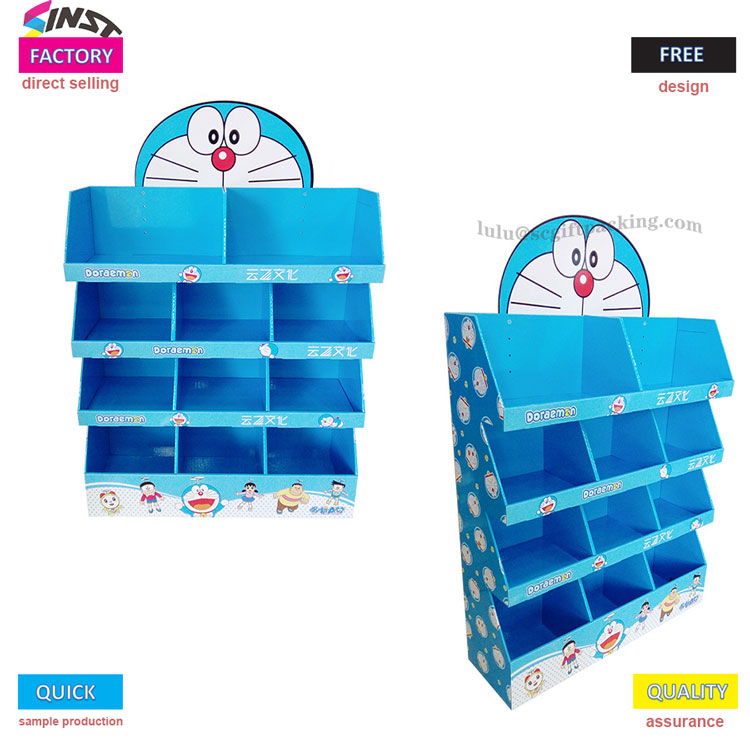
To safely hold heavy biscuit tins, the structural materials must resist both compression and bending. Sinst manufactures these high-capacity units using a dual-material approach: a rigid 1500gsm cardboard core laminated with 157gsm art paper.
The 157gsm art paper handles the visual requirements. It provides a smooth, bright white surface that accepts high-resolution printing for the bright blue tones and cartoon graphics necessary to attract shoppers in bakeries and convenience stores. But the heavy lifting happens beneath that surface.
The 1500gsm cardboard acts as the structural skeleton. Unlike thin E-flute corrugated board that crushes easily, high-density 1500gsm board resists bending under sustained loads. To maximize this material strength, the rack utilizes a four-layered grid design.
This grid fundamentally changes how weight transfers to the floor. Instead of spanning an empty void between two side walls, the interlocking shelves and vertical supports create a matrix of right angles. The central vertical dividers act as load-bearing pillars, taking the weight of the heavy gift boxes from the top tier and transferring it directly down through the structure to the base.
To solve the moisture wicking problem, these displays integrate non-slip silicone pads at the base. These pads elevate the raw cardboard edges a fraction of an inch above the floor, breaking the capillary action of wet mops while providing enough friction to prevent the rack from sliding when bumped by a shopping cart.
Reinforcing Shelf Integrity With Adjustable Dividers
Buyers typically view adjustable dividers as an organizational tool—a way to keep small bags of cookies neat. From an engineering perspective, they are critical structural components.
When a divider slots tightly into the back panel and the front lip of a shelf, it provides cross-bracing. It locks the shelf at a perfect 90-degree angle to the back wall. If a heavy tin is placed near the front edge, the divider resists the downward lever-action that would normally tear the shelf away from the backboard. By making these dividers adjustable, merchandisers can configure the grid tightly around the specific dimensions of the product, minimizing empty space that allows tall boxes to tip and shift.
Maximizing Merchandising Space for Heavy Biscuit Tins and Gift Boxes
Space efficiency in a supermarket aisle is a strict mathematical calculation. You have a limited footprint, usually restricted by the dimensions of an endcap or a free-standing aisle perimeter. The goal is to maximize the volume of product on the floor without compromising stability.
A 4-tier design allows for strategic weight distribution. The physical law of retail displays dictates that the heaviest items must anchor the bottom. Merchandisers should load dense, metal biscuit tins and multi-pack gift boxes onto the bottom two tiers. This drastically lowers the center of gravity, making the display resistant to tipping.
The top two tiers should hold lighter items: foil-bagged treats, seasonal snacks, or loose cookies. Because the 1500gsm structural grid supports the entire unit, the upper shelves will not sag, but keeping the heavy mass low ensures the rack remains stable even as shoppers deplete the inventory aggressively over a weekend.
Integrating NFC Chips for Omnichannel Retail Tracking in 2026
Physical durability is only half the requirement for modern retail fixtures. Brands now need to know exactly what is happening to their displays in the field. Sinst addresses this by embedding NFC (Near Field Communication) chips directly into the cardboard structure during the manufacturing process.
These chips sit invisibly behind the 157gsm art paper. They require no batteries and are completely protected from tampering. For the brand's field representatives, tapping a smartphone to the side of the display logs the exact time and location of the setup, proving compliance with supermarket placement agreements. When those heavy biscuit tins sell out, store managers can tap the same chip to instantly reorder stock.
For the consumer, the NFC chip bridges the physical and digital shopping experience. A quick tap can open a web page detailing allergen information, offering a digital coupon, or showing recipes that use the displayed cookies. It turns a static piece of cardboard into an interactive point of sale.
Procurement Checklist for Custom Retail Biscuit Floor Display Racks
Sourcing cardboard displays that will actually survive a four-week retail promotion requires checking specific engineering tolerances. Do not accept vague promises about durability. Use this checklist when specifying a shopping mall biscuit cardboard display rack for heavy merchandise:
-
Core Material Density: Demand a minimum of 1500gsm cardboard for the structural core to prevent creep and center-shelf sagging under heavy tins.
-
Print Surface: Specify 157gsm art paper lamination to ensure high-fidelity reproduction of brand colors and cartoon graphics without compromising structural integrity.
-
Base Protection: Require non-slip silicone pads or a plastic base tray to completely isolate the cardboard from floor moisture and scrubber damage.
-
Grid Architecture: Ensure the design uses full-height vertical dividers that transfer weight directly to the floor, rather than relying solely on the outer walls.
-
Cross-Bracing: Verify that the adjustable dividers physically lock into both the front lip and back panel to prevent lateral twisting.
-
Manufacturing Certifications: Look for facilities operating under ISO9001 for quality control, BSCI and SEDEX for ethical labor practices, and FSC certification to guarantee the 100% recyclable materials are sustainably sourced.
If your current displays are buckling before the promotion ends, it is time to upgrade your specifications. You can configure a high-capacity, heavy-duty solution by reviewing the technical options for a custom retail biscuit floor display rack built to handle actual supermarket conditions.

 English
 Español
 Português
 русский
 Français
 日本語
 Deutsch
 tiếng Việt
 Italiano
 Nederlands
 ภาษาไทย
 Polski
 한국어
 Svenska
 magyar
 Malay
 বাংলা ভাষার
 Dansk
 Suomi
 हिन्दी
 Pilipino
 Türkçe
 Gaeilge
 العربية
 Indonesia
 Norsk
 تمل
 český
 ελληνικά
 український
 Javanese
 فارسی
 தமிழ்
 తెలుగు
 नेपाली
 Burmese
 български
 ລາວ
 Latine
 Қазақша
 Euskal
 Azərbaycan
 Slovenský jazyk
 Македонски
 Lietuvos
 Eesti Keel
 Română
 Slovenski
 मराठी
 Srpski језик