


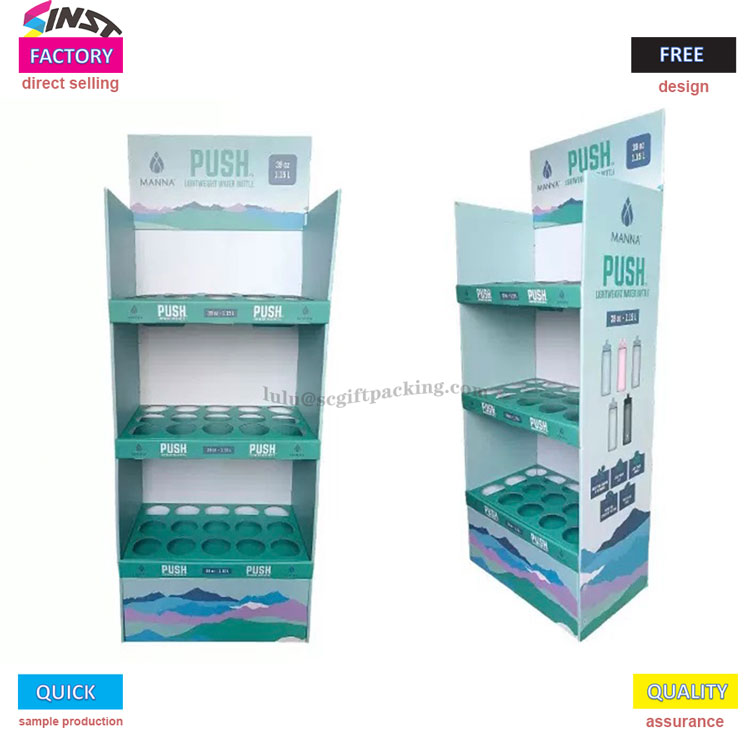
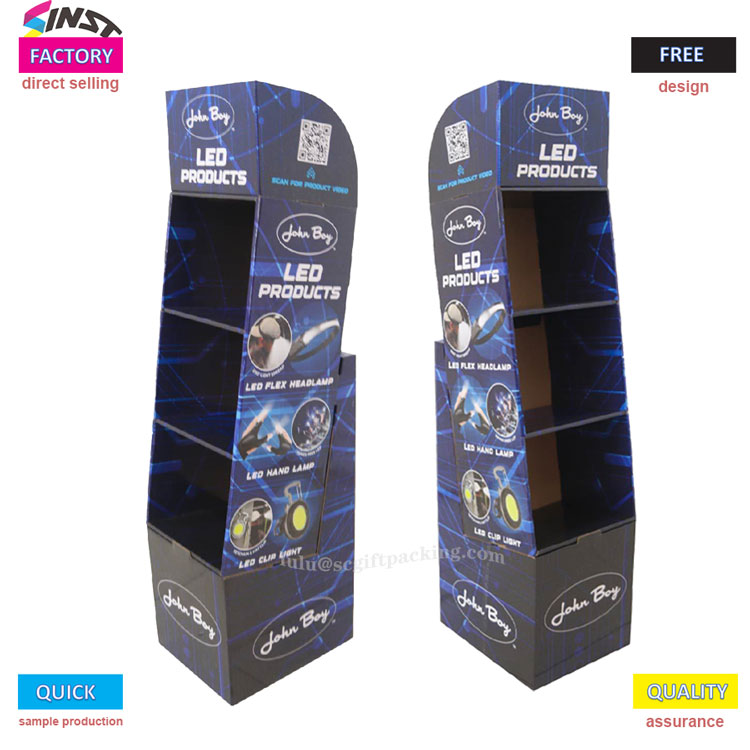
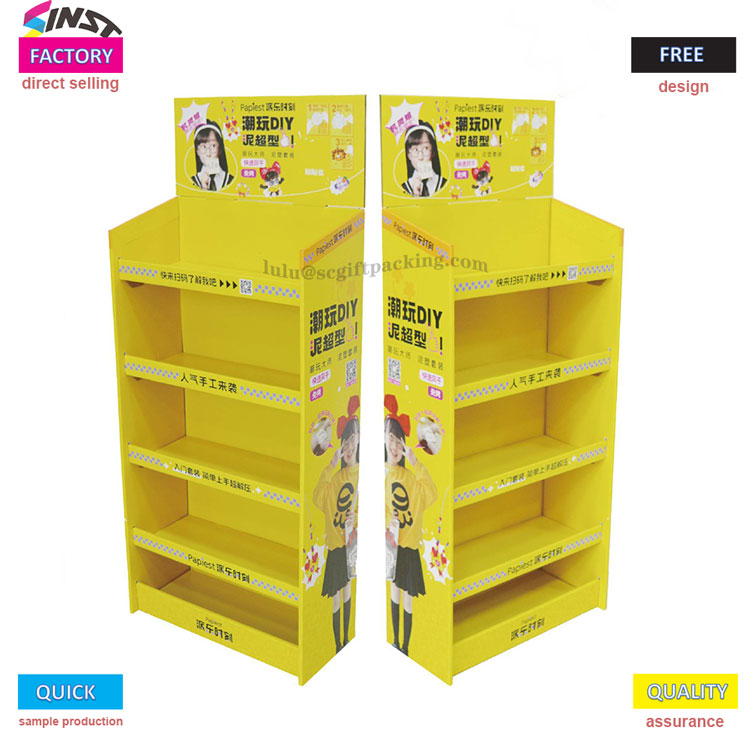

Start with the campaign objective: visibility, impulse purchase, organized assortment, or faster replenishment
Choose the display format only after deciding what the campaign must accomplish. A tall floor unit can create visibility across an aisle, but it may be the wrong answer beside a crowded convenience-store register. A countertop display earns fewer total facings yet puts the product directly in the purchase path. Tray systems keep multiple flavors organized. Dump bins emphasize abundance, while hook-based displays separate small packaged extensions from cans and bottles.
For 2026 retail media campaigns, the display may also carry QR codes, promotional identifiers or creative tied to a retailer’s digital advertising. That makes graphics and scan position part of the operating brief—not decoration added after the structure is approved.
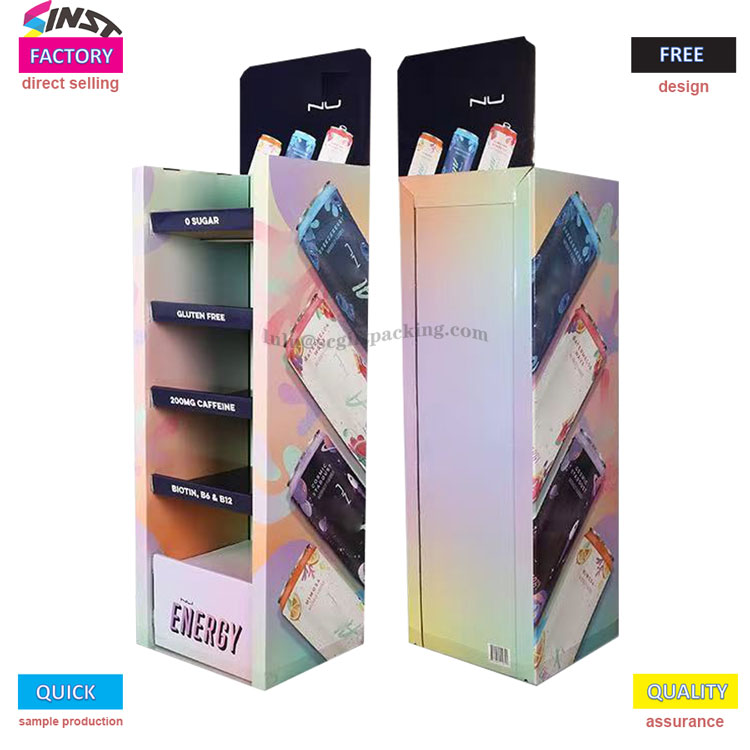
Five cardboard display formats serve different placement and shopping behaviors
The useful classification criterion is how shoppers access the product and where the retailer allows the unit to sit. That produces five distinct formats: tiered floor displays, tray displays, countertop displays, dump bins and hook-based displays. They aren’t interchangeable.
Tiered floor displays and tray displays provide structured facings for cans, bottles, and multiple SKUs
A tiered floor display presents products on stepped or stacked shelves, giving each row a visible facing. It suits a retail energy drink floor display intended to carry several flavors or bottle variants without mixing them together. The trade-off is structural demand: every shelf, divider and sidewall must perform under the full beverage load.
Tray displays organize products in open-front trays. Trays may form part of a floor unit or be positioned on an approved shelf or counter. They’re useful when replenishment speed and SKU separation matter more than dramatic height. Sinst’s custom Energy Soda Display Stand is described as a multi-layer cardboard beverage display for 350–600 ml bottles, with custom sizing available.
Countertop displays, dump bins, and hook-based displays suit compact placements, loose products, or lightweight packaged extensions
An energy drink countertop display rack is built for tight, high-contact locations such as checkout counters, gym reception desks and promotional tables. Capacity is limited, and the retailer may impose strict footprint or sightline rules.
Dump bins offer open access and quick loading, but they’re often a poor default for heavy bottles. Products can become disordered, lower units may be difficult to reach, and sidewalls take unpredictable impact as shoppers rummage. Hook-based displays are better reserved for lightweight hanging packs or related packaged items. Hanging heavy beverages from paperboard pegs without purpose-designed reinforcement is an avoidable failure mode.
Product dimensions and filled weight should eliminate unsuitable formats before design begins
Graphics can’t rescue a structure that was selected from an empty package image. Beverage projects should begin with physical samples or controlled dimensional data. Filled weight matters more than nominal volume, and a slim can, contoured bottle and multipack impose different contact points on shelves and dividers.
Record can or bottle dimensions, package shape, SKU mix, orientation, and required replenishment access
Document the maximum package width, depth and height across every SKU in the campaign. Include cap profiles, shoulder shapes, shrink wrapping and any variation that could cause snagging. State whether products face forward, load from the front or drop into a tray from above.
SKU mix changes the internal layout. Equal columns may work for a balanced assortment, while a best-selling flavor may need more facings. Replenishment access deserves the same attention: staff shouldn’t have to remove signage or unload an upper shelf to refill the level below.
Validate loaded capacity, center of gravity, shelf support, handling conditions, and stability through structural samples and testing
Ask for a structural sample and test it with the intended products, not empty containers. Observe shelf deflection, bowing sidewalls, divider movement and the unit’s behavior when stock becomes uneven. A display that stands safely when full can become less stable after shoppers remove products from one side.
Handling conditions also count. Determine whether the display ships flat, is assembled in a store, or arrives packed with product. Test the agreed configuration through the handling sequence required by the retailer and distribution program. Sinst lists sample availability for its cardboard beverage display rack; the final validation plan should still be written around your load and route to store.
Compare displays under real supermarket, convenience-store, gym, and gas-station operating conditions
| Format | Best operating fit | Main advantage | Common limitation |
|---|---|---|---|
| Tiered floor display | Supermarket promotional zones and open gym retail areas | High visibility and organized facings | Requires floor approval, structural support and more assembly |
| Tray display | Supermarkets, convenience stores and replenishment-led programs | Clear SKU separation and practical restocking | Less visual height unless integrated into a floor structure |
| Countertop display | Registers, reception desks and compact gas-station placements | Strong impulse position in a small footprint | Low capacity and strict counter-space competition |
| Dump bin | Open promotional areas with simple assortments | Fast loading and an abundance cue | Products become disorganized; heavy loads need careful engineering |
| Hook-based display | Side panels and small packaged product extensions | Uses vertical space and separates hanging items | Generally unsuitable for heavy bottles or cans without specialized support |
Store conditions can overturn a paper comparison. Supermarkets may provide more floor area but enforce detailed merchandising and safety rules. Convenience stores and gas stations favor compact footprints and rapid replenishment. Gyms may offer direct access to the target shopper, though placement can be narrow and lightly staffed. Confirm the retailer’s allowed footprint, height, aisle clearance, assembly method and disposal process before approving artwork.
QR-enabled retail media and recyclable display programs require separate design and evidence decisions
A QR code needs a flat, visible panel, sufficient printed contrast and a position shoppers can scan without bending around stocked bottles. Test the final printed sample at the expected distance and under store lighting. Campaign-specific URLs or identifiers can help distinguish scans by retailer or placement, but the measurement plan belongs to the media program, not the cardboard structure itself.
Recyclability needs its own material review. Sinst lists 157 gsm art paper mounted to 1500 gsm cardboard, CMYK or Pantone printing, and lamination or varnish finish options for this category. Finish, adhesive, labels and non-paper fittings can affect acceptance in local recycling systems. Don’t describe a complete display as recyclable solely because its main component is cardboard.
Sinst reports ISO 9001, ISO 14001, BSCI, SEDEX and FSC certifications at the company level. Buyers should request current documents and confirm their scope, facility coverage and relevance to the ordered materials rather than presenting company certifications as automatic certification of every finished display.
Use a quote-ready checklist to confirm format, graphics, retailer requirements, assembly labor, testing, certification scope, campaign duration, production timing, shipping, and delivered cost
- Format: Name the placement and chosen structure—tiered floor, tray, countertop, dump bin or hook-based.
- Product data: Supply filled samples, dimensions, weight, SKU count, orientation and target capacity.
- Graphics: Confirm print colors, finish, QR placement, campaign versions and required retailer marks.
- Retailer requirements: Record footprint, height, aisle, safety, disposal and packaging rules.
- Labor: State who assembles, loads, replenishes and removes the unit.
- Testing: Agree on structural samples, loaded evaluation and distribution or handling checks.
- Claims and documents: Verify material claims and the scope of any requested certification.
- Schedule: Include campaign duration, sample approval, production timing and store delivery dates.
- Commercial terms: Compare tooling, unit price, packing, freight, duties, storage and delivered cost. Sinst lists a 1,000-piece MOQ for this product category, so volume should be checked before design work proceeds.