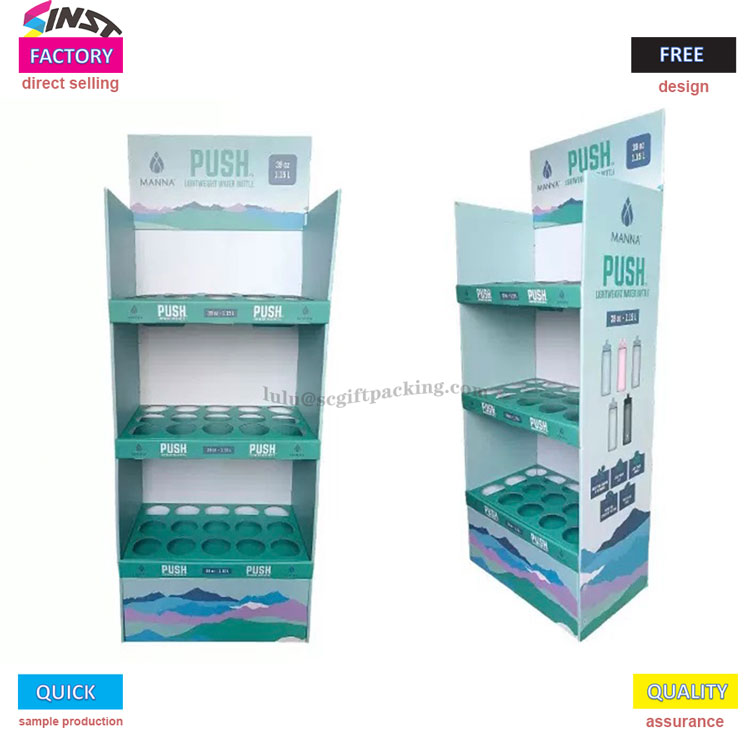
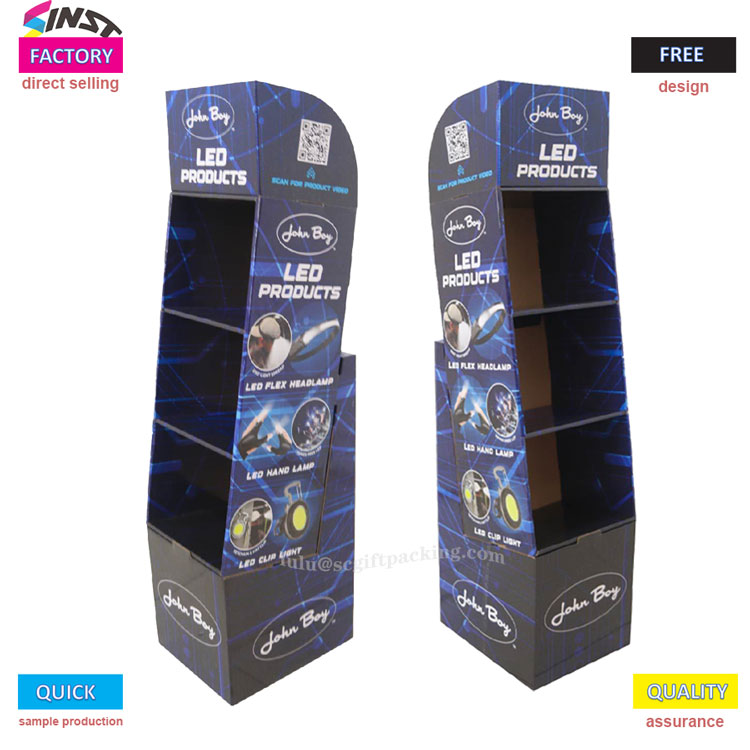
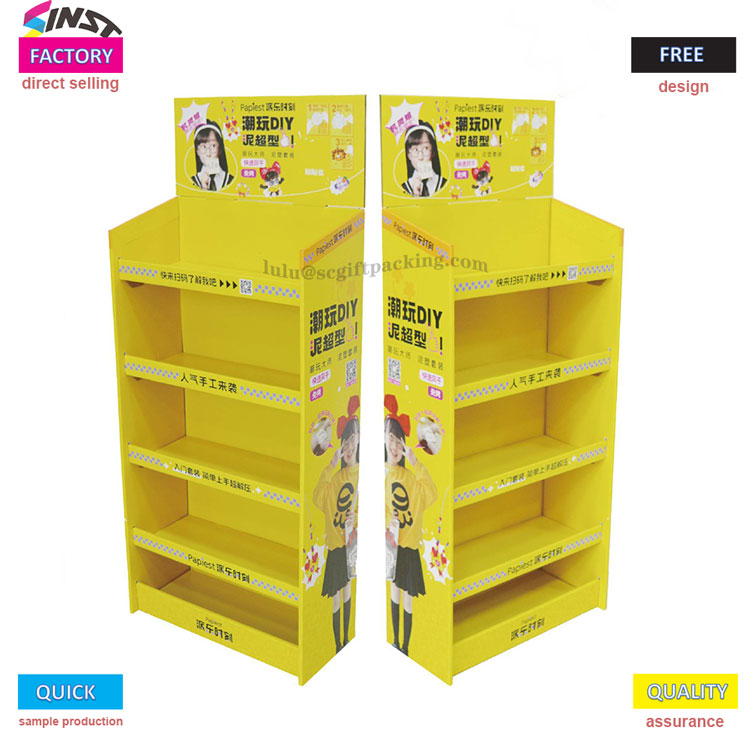
Yes—Sinst can customize the rack around your doll assortment, campaign graphics, store placement, and packing needs
Yes. Sinst can develop a custom cardboard doll display rack around the dimensions of your packaged dolls, the number of SKUs you need to present, your campaign artwork, and the floor space available at the store. The featured format is a four-tier adjustable cardboard rack with removable compartments, but the final size and layout are project-specific.
Customization should start with the merchandise, not the artwork. A display may look correct in a rendering yet fail on the sales floor because the packages catch on a divider, hide the product below, or leave too much empty space. Accurate product measurements and physical samples help prevent those mistakes.
Sinst supplies POP cardboard display racks and related paper packaging to brands, retailers, publishers, advertisers, and other business buyers. You can review the basic format of its custom cardboard doll display rack before preparing your project brief.
Choose the structural and visual options that support the promotion
The right configuration depends on what the display must hold, how shoppers will remove products, and how store staff will replenish it. Structural choices and print choices should be reviewed together. A large header may improve campaign visibility, for example, but it also affects the overall packed size and the display’s position under store fixtures.
Define doll dimensions, packaged weight, SKU count, shelf capacity, tier spacing, and removable compartment layout
Provide the length, width, height, and packaged weight of every product going into the display. Don’t submit only the doll dimensions if the item is sold in a window box, blister pack, or blind box. The retail package is what determines shelf depth, tier clearance, divider position, and front-facing visibility.
Your structural brief should answer six practical questions:
-
How many packaged dolls or figurines should each tier hold?
-
Will each compartment contain one SKU or a mixed assortment?
-
Do staff need removable dividers for assortment changes?
-
How much of the package front must remain visible?
-
Will customers lift products out or pull them forward?
-
What floor footprint and overall height will the retailer accept?
Sinst’s stated four-tier format and removable compartments allow the layout to be adapted, but “adjustable” shouldn’t be read as unlimited. Package size, weight distribution, access, and the die-cut structure still set practical boundaries. Shelf capacity should be confirmed against the actual assortment during sampling rather than assumed from appearance.
Coordinate CMYK or Pantone artwork, branding panels, promotional messages, and optional lamination or varnish
Sinst offers CMYK or Pantone printing. CMYK is commonly used for photographic artwork and multi-color campaign graphics, while specified Pantone colors may be preferable when a brand color needs closer control. Your files should identify the header, side panels, shelf fronts, compartment faces, and any areas that must remain free of text because they fold, lock, or receive product.
Optional lamination or varnish can change the finish and handling characteristics of printed surfaces. That choice also introduces a trade-off: coatings and films may affect how the display enters local recycling streams. If recyclability is central to the promotion, ask Sinst to document the proposed material and finish combination instead of treating every coated paper display as equivalent.
Adapt one display concept for toy stores, mass retail, blind-box launches, and temporary promotional events
A single printed cardboard toy display shelf can be developed for different retail settings, but the priorities change.
|
Retail setting
|
What to prioritize
|
|
Toy store
|
Clear character grouping, easy product access, and enough front-facing package visibility for comparison.
|
|
Mass retail
|
Defined floor footprint, straightforward assembly, replenishment access, and packing instructions that match the retailer’s handling requirements.
|
|
Blind-box launch
|
Compartment count, mixed-SKU control, shelf-front messaging, and a layout that doesn’t reveal or confuse the intended assortment.
|
|
Temporary event
|
Fast setup, transport planning, campaign-specific graphics, and a quantity matched to participating locations.
|
A four-tier doll display rack may work well for a compact assortment, but more tiers aren’t automatically better. Tight spacing can obscure package graphics and make restocking awkward. Fewer, clearly separated product rows may be the better commercial decision when packages are tall or visually detailed.
Review the physical sample and production plan before committing to volume
A physical sample is the point where assumptions become visible. Sinst states that samples are available, with a three-to-five-day sample lead time after payment. Use that stage to test the display with actual retail packages whenever possible.
Use the sample to confirm product fit, four-tier adjustability, compartment access, graphics, assembly, and replenishment
Load the sample as it would be loaded in a store. Check that products sit flat, don’t snag on dividers, and can be removed without pulling adjacent items forward. Confirm that the upper tiers don’t hide products below and that removable compartments stay practical once the display is fully stocked.
Assembly deserves the same attention. Ask the person testing the sample to follow the proposed instructions rather than relying on the designer’s guidance. Misread tabs, reversed shelves, and unclear fold sequences are common sources of store-level frustration. The sample should also reveal whether barcodes, legal copy, character artwork, and promotional messages remain visible after folding and loading.
Plan around the stated three-to-five-day sample lead time, 12-to-15-day delivery time after deposit, flat packing, and export cartons
Sinst lists a three-to-five-day sample lead time after payment and a 12-to-15-day delivery time after deposit. Confirm what the quoted delivery period covers for your order, particularly when the displays are shipping to the United States. Production timing, transit, customs clearance, and delivery appointments are separate planning points unless the quotation states otherwise.
Flat packing can reduce the space occupied by assembled displays, but it shifts assembly to a warehouse, store, or event team. Specify who will build and load each unit. Also confirm the number of displays per export carton, carton markings, instruction sheets, and any destination-specific packing requirements before production.
Verify the stated paper construction and request project-specific sourcing or compliance evidence
The product page states a material combination of 157 gsm art paper and 1,500 gsm cardboard, with recyclable paper-based construction. Those figures describe the listed product, not a universal specification for every assortment. Final material selection should account for package weight, shelf dimensions, divider design, printing, finish, packing method, and expected use period.
“Paper-based” also doesn’t by itself prove acceptance in every U.S. recycling program. Local collection rules vary, especially for laminated or heavily coated components. If your retailer or corporate policy requires sourcing records, material declarations, testing, or specific compliance documents, request them for the exact production configuration. Don’t rely on a generic sustainability statement.
Request a quotation for 1,000 or more displays with artwork files, product details, quantity, packing requirements, and US destination
Sinst states a 1,000-piece minimum order quantity. For an accurate quotation, send packaged product dimensions and weights, SKU count, desired capacity per tier, target display size, artwork files, required quantity, finish preference, packing instructions, and the U.S. delivery destination. Include retailer routing or carton-label requirements if they’re already known.
Use the Cute Children Toy Doll Display Rack product page to request pricing and a sample plan. Ask the quotation to identify the proposed structure, print method, surface finish, export-carton configuration, sample cost, production terms, and what the stated delivery schedule includes.

 English
 Español
 Português
 русский
 Français
 日本語
 Deutsch
 tiếng Việt
 Italiano
 Nederlands
 ภาษาไทย
 Polski
 한국어
 Svenska
 magyar
 Malay
 বাংলা ভাষার
 Dansk
 Suomi
 हिन्दी
 Pilipino
 Türkçe
 Gaeilge
 العربية
 Indonesia
 Norsk
 تمل
 český
 ελληνικά
 український
 Javanese
 فارسی
 தமிழ்
 తెలుగు
 नेपाली
 Burmese
 български
 ລາວ
 Latine
 Қазақша
 Euskal
 Azərbaycan
 Slovenský jazyk
 Македонски
 Lietuvos
 Eesti Keel
 Română
 Slovenski
 मराठी
 Srpski језик